
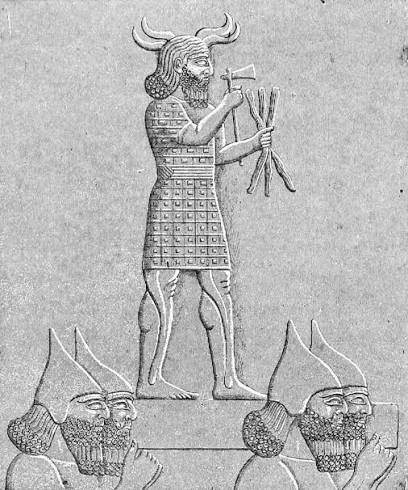
Baal-Hadad was the principal god of storms, rain, thunder, and agricultural fertility in the ancient religion and mythology of the peoples of the Levant and Canaan. The term Baal (בעל) means “lord,” “owner,” or “master,” having originally been an epithet of Hadad that, over time, came to be used as his proper name — which can give rise to confusion, since there are various gods called Baalim (the plural of Baal).
Baal-Hadad is regarded as the king of the gods, the guarantor of law, of social order, and of the balance between heaven and earth, as well as being the principal source of life for the agriculture of the Levant. The god is also called the “Rider of the Clouds” (rkb’rpt) and “Prince, Lord of the Earth” (Zbl Bal Arş).
For more than two thousand years, Baal-Hadad was one of the most worshipped and influential gods of the Near East, also holding great importance in local politics and in the administration of justice. Kings such as Zakkur of Hamath claimed that Baal had made them sovereigns; thus, royal authority was seen as directly granted by Baal, and the laws imposed by the king were considered to be ordained by him. The monarch, as the god’s representative, had the obligation to promote “righteousness, peace, and well-being” among the people. Should he fail in this responsibility by ruling unjustly, Baal would punish him, often by sending an enemy army to destroy the kingdom.
In the military context, Baal was seen as a warrior god who marched with the armies. Kings turned to him in times of war, and he responded through prophets, promising to deliver the king from his enemies. Success in battle was interpreted as a sign of Baal’s favor.
The principal narrative concerning Hadad is found in the Baal Cycle (or the Cycle of Baal and Anat), an epic preserved on clay tablets discovered at Ras Shamra (ancient Ugarit) in the 1920s. The cycle narrates Baal’s rise to power and his struggle against other gods who opposed him, such as Yam (the sea) and Mot (death).
The cycle reflects the agricultural calendar of the Levant and also influenced the cult of the god:
Summer: Baal reigns normally and brings blessings to the people. The cult is celebrated with generous offerings, banquets, and rituals of thanksgiving for the rains and the harvests.
Autumn: Baal gradually weakens, and the cult becomes more silent, with fewer offerings.
Winter: Baal “dies” or descends to the underworld. People wept, expressed sorrow, made supplications, and, in some cases, practiced self-flagellation with knives and spears until blood was shed, as a way of demonstrating extreme devotion and sharing in Baal’s suffering.
Spring: Baal resurrects or returns. The people held feasts and abundant celebrations, with fertility rituals that included symbolic sexual practices, representing the return of the rains and of life to the earth.
The cult was conducted in urban temples and on the so-called bamot (hills or high places where altars were erected), for it was believed that elevation facilitated communication with the god. Mount Safom (Jebel Aqra), north of Ugarit, was considered his celestial dwelling and a place of pilgrimage among the devotees of Baal-Hadad.
To Baal were offered bread, wine, olive oil, fruits, beer, incense, and so on, as well as animal sacrifices, such as bulls, rams, doves, and sheep, which were given whole or in parts. These offerings were burned upon the altars in certain rituals and, in others, distributed among the participants (kings, priests, and the people).
There is no evidence that Baal-Hadad received child sacrifices; the Baal Cycle itself describes offerings of animals, banquets, and fertility rituals, but never mentions children. Infant sacrifices are associated with Baal-Hammon, another Baalim god, worshipped mainly in North Africa and Carthage.
 Shams Bael - 𐎁𐎓𐎍
Leave a comment